Elm: A Bold Display Font for Handmade Labels & Craft Projects
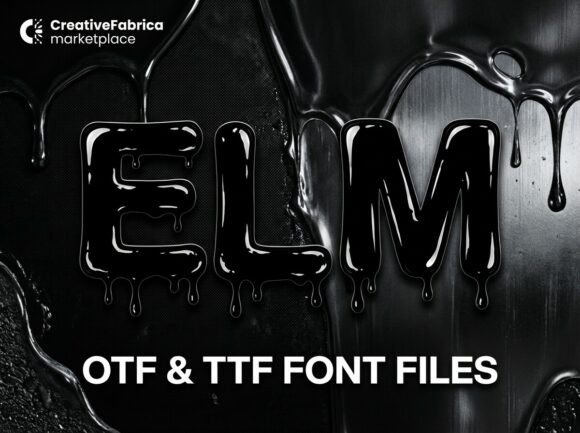
If you’ve ever held a hand-poured candle with a glossy black label that made you pause, or admired a farmhouse-style welcome sign where the letters looked like they’d been dipped in liquid onyx—you know the power of a truly distinctive display font. That’s Elm: a visceral, ultra-thick typeface with rounded letterforms and a high-gloss “onyx-oil” finish that doesn’t just sit on the page—it pools, commands, and lingers in memory.
As someone who designs printable wall art, cuts vinyl stickers for boutique boutiques, and crafts wedding stationery that ships to thirty states, I reach for Elm when I need instant presence. It’s not subtle—and it’s not meant to be. Elm lives in the space between luxury packaging and raw handmade charm. Its weight and curvature make it incredibly legible at larger sizes, especially on physical products where clarity meets character.
Where Elm Shines in Real Craft Projects
Elm excels where impact matters most: short phrases, names, titles, and decorative accents. Think welcome on a wooden wedding sign, small batch stamped on a honey jar, or hand-poured curved across a soy candle label. Its rounded terminals soften its boldness—so it feels warm, not aggressive. That’s rare in a display font this heavy.
I’ve used Elm for:
- Candle and soap labels — The thick strokes hold up beautifully when printed small (down to 14pt) on matte kraft paper or glossy sticker stock.
- Wedding welcome boards and seating charts — Paired with a delicate script for names, Elm anchors the layout with grounded elegance.
- Seasonal SVG bundles — Its clean curves cut flawlessly on Cricut and Silhouette machines, even at 2–3 inches tall on acrylic ornaments or wood slices.
- Digital printables — Planner covers, quote pages, and boutique gift tags gain instant shelf appeal with Elm as the headline font.
- Mugs, totes, and apparel — Because of its generous spacing and open counters, it prints crisply in screen-printed or DTG workflows—even on textured fabrics.
Readability & Production Tips You’ll Actually Use
Elm isn’t built for paragraphs—but it’s *designed* for real-world craft constraints. Its letterforms avoid tight inner spaces (like the eye of an ‘e’ or the bowl of a ‘d’), so ink doesn’t bleed on porous paper or vinyl. When cutting with a machine, I always convert text to outlines first—Elm’s smooth curves handle path simplification without distortion.
For small stickers under 1 inch wide? Stick to 2–3 words max—locally made, rose gold, or just married. Avoid using Elm below 10pt in print unless you’re laser-engraving into wood or metal, where its weight translates into tactile depth.
Smart Pairings That Elevate Your Brand
Elm thrives in contrast. Its richness calls for balance—not competition. Here’s what works in my shop:
- With a soft script — Try Elm for headlines paired with a relaxed handwritten font for body text on invitations or thank-you cards. The combo feels personal yet polished.
- With a clean sans serif — Use Elm for product names and a neutral sans (like Montserrat or Inter) for ingredients, care instructions, or pricing. This pairing reads as intentional, not cluttered.
- With a quiet serif — For vintage-inspired packaging or apothecary labels, pair Elm with a low-contrast serif like Lora or Playfair Display. The serif adds refinement; Elm adds authority.
Avoid pairing Elm with other bold display fonts or tightly spaced condensed typefaces—they’ll fight for attention instead of supporting your message.
Licensing, Formats & What’s Included
Elm comes as a premium font package with OTF and TTF files—fully compatible with Canva, Adobe Creative Cloud, Cricut Design Space, and Silhouette Studio. It includes standard OpenType features like stylistic alternates and ligatures (great for avoiding awkward letter collisions in words like “coffee” or “bouquet”). While it’s optimized for English-language use, basic Latin characters cover most craft needs—from Spanish café tags to French bakery labels.
Crucially, Elm includes a commercial license that covers selling physical products (like mugs, candles, or greeting cards), digital downloads (printables, SVGs, Canva templates), and client work—including logos and branding assets. Just remember: you can’t resell or redistribute the font file itself, and embedding in web fonts requires separate licensing.
Why Elm Builds Trust—and Sales
In a crowded Etsy feed or Instagram scroll, typography is often the first cue customers use to judge quality. Elm signals intentionality. Its gloss-like finish suggests care in design; its thickness implies substance. When a customer sees Elm on your product tag, they don’t just read “lavender soap”—they register crafted, considered, distinct.
That impression carries over to brand consistency. Using Elm across your packaging, social graphics, and website headers creates visual rhythm—so whether someone sees your sticker on a laptop or your invitation in their mailbox, they recognize your voice before they see your logo.
It also deepens emotional resonance. There’s something quietly confident about Elm—not flashy, but unshakable. That makes it perfect for wellness brands, wedding vendors, artisan food makers, and home décor sellers who want their typography to feel like part of the experience—not just decoration.
If you’re choosing your next display font, ask yourself: does it serve the product, the person holding it, and the story you’re telling? Elm does—all while looking like it belongs on something beautiful, made by hand.